

- The year 2025 was a dynamic year for northbound MRF products, shaped by policy support, market performance disparities between onshore Chinese assets and the rest of the world, and resulting changes to investor preferences. The relaxation of the cap on the value of units of a northbound MRF product sold to investors in the Chinese mainland from 50% to 80% of the fund’s total assets on Jan. 1, along with a pent-up demand from Chinese investors wishing to diversify their investments, triggered a buying spree for northbound MRF products from Chinese investors in the early months. The US tariff tantrum in April briefly disrupted the positive flow momentum, prompting net outflows in the second quarter, yet consecutive inflows in the third and fourth quarters left fixed-income, equity, and allocation MRF funds ending the year with positive inflows.
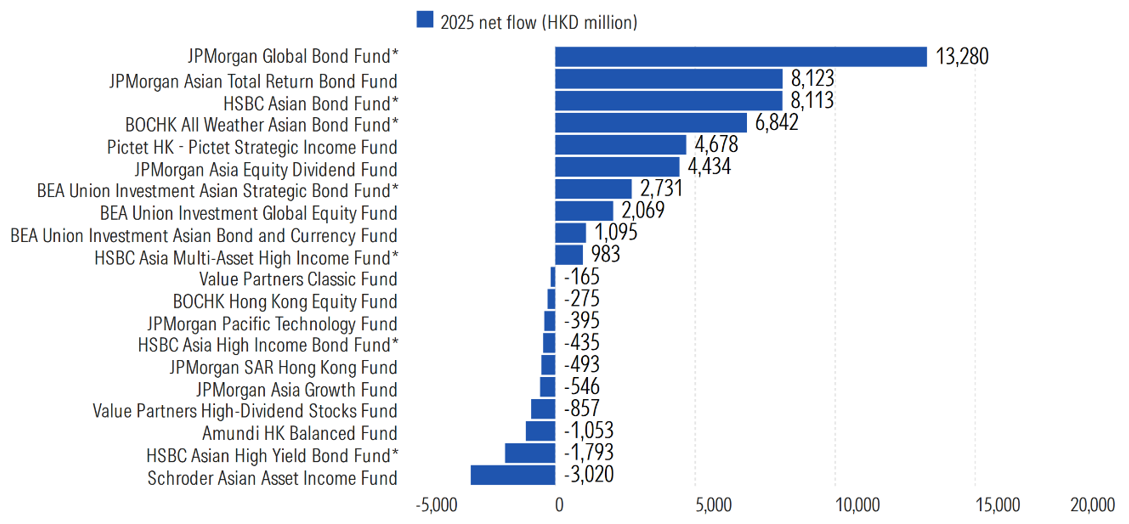
- Fixed-income products attracted the most inflows in 2025. Chinese investors’ search for higher yields amid a low domestic interest rate environment, combined with an expanded mainland sales quota, drove a surge of capital into northbound fixed-income MRFs in the first quarter. Several products hit the revised 80% mainland sales cap shortly after reopening for subscriptions and had to suspend new sales. For the rest of the year, the asset class saw moderate outflows as the rebound in Chinese A-shares and Asian equities drew some investors away from fixed-income products, albeit to a lesser extent than the strong inflows witnessed in the first quarter. JPMorgan Global Bond, the sole global bond MRF offering, led the flow league table with HKD 13.28 billion in net new money for the whole year. Close behind were several Asian bond funds: JPMorgan Asian Total Return Bond and HSBC Asian Bond each attracted over HKD 8.0 billion, while BOCHK All Weather Asian Bond pulled in HKD 6.84 billion for the year. HSBC Asian High Yield Bond and HSBC Asia High Income Bond, however, faced redemption from the second quarter onward. In general, such aggressively positioned Asian fixed-income funds with sizable stakes in high-yield bonds saw muted investor interest in 2025. Furthermore, mainland sales quotas for both funds were exhausted, which constrained inflows and ultimately led them to end the year among funds with the largest net outflows.
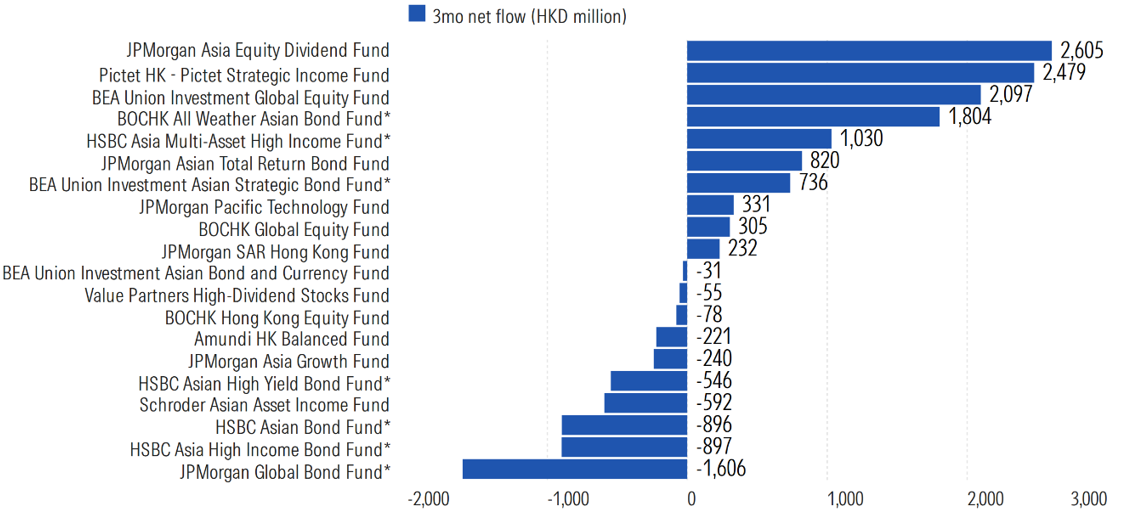
- Equity products finished the year with modestly positive inflows. This asset class experienced net outflows in the first half of the year, but Asia-focused strategies turned the tide since the third quarter and global funds rebounded in the fourth quarter, jointly driving the year’s overall net inflows. JPMorgan Asia Equity Dividend, which targets a forward portfolio yield 30% above the MSCI AC Asia Pacific ex Japan Index, topped the quarterly net inflows in both the third and fourth quarters and ranked among the top 10 in annual net inflows. Its superior returns in 2025 compared with its Asia-Pacific ex-Japan Equity Income category peers and the majority of the other MRF funds attracted significant investor interest. BEA Union Investment Global Equity witnessed strong inflows amounting to HKD 2.10 billion in the fourth quarter, which was pivotal in enabling the fund to rank among the top 10 in annual net inflows.
- Allocation funds saw relatively muted flows in the first three quarters, but a surge in the fourth quarter propelled them into seeing positive net inflows for 2025. Pictet HK—Pictet Strategic Income, a flexible-allocation fund investing across global equities and fixed income, emerged as the top capital-getter among allocation funds for both the fourth quarter and the full year. Conversely, Asia-focused Schroder Asian Asset Income suffered the largest net outflows in 2025, shedding HKD 3.02 billion.
Top 10 and Bottom 10 MRF Northbound Funds by 3-Month Net Flow
Top 10 and Bottom 10 MRF Northbound Funds by 2025 Net Flow
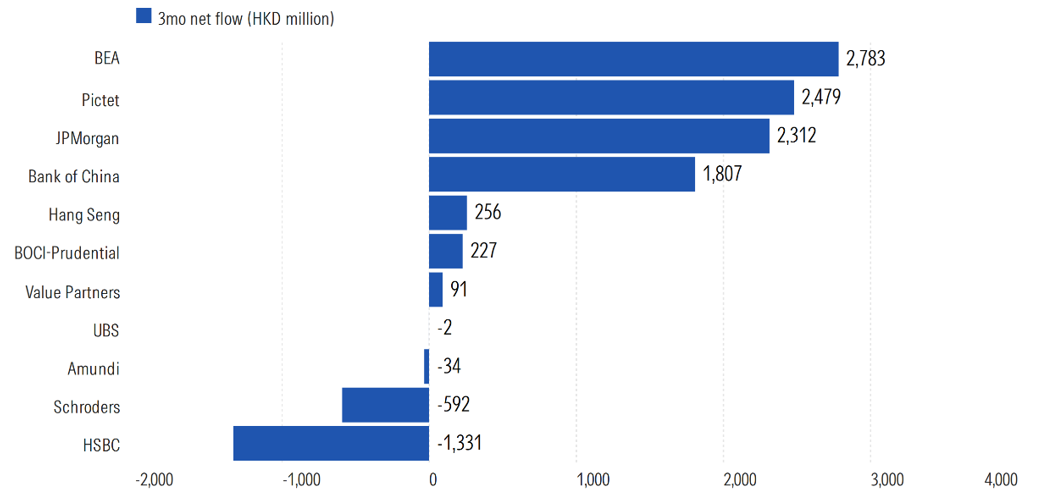
- At the fund house level, BEA led the way in terms of inflows over the past three months, mainly due to the strong net inflows of BEA Union Investment Global Equity in the fourth quarter. Pictet and JPMorgan closely followed, both of which had inflows exceeding HKD 2 billion. HSBC and Schroders ranked at the bottom.
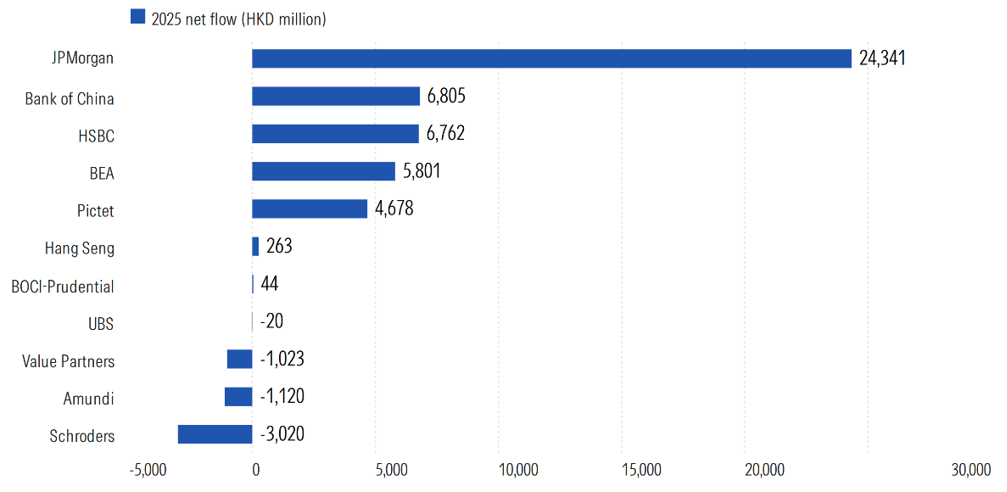
- On an annual basis, JPMorgan took the lead, with annual net inflows reaching HKD 24.34 billion. Bank of China and HSBC followed, both having annual net inflows of over HKD 6 billion. Schroder had net outflows of over HKD 3 billion and ranked last.
Top MRF Northbound Fund Houses by 3-Month Net Flow
Top MRF Northbound Fund Houses by 2025 Net Flow
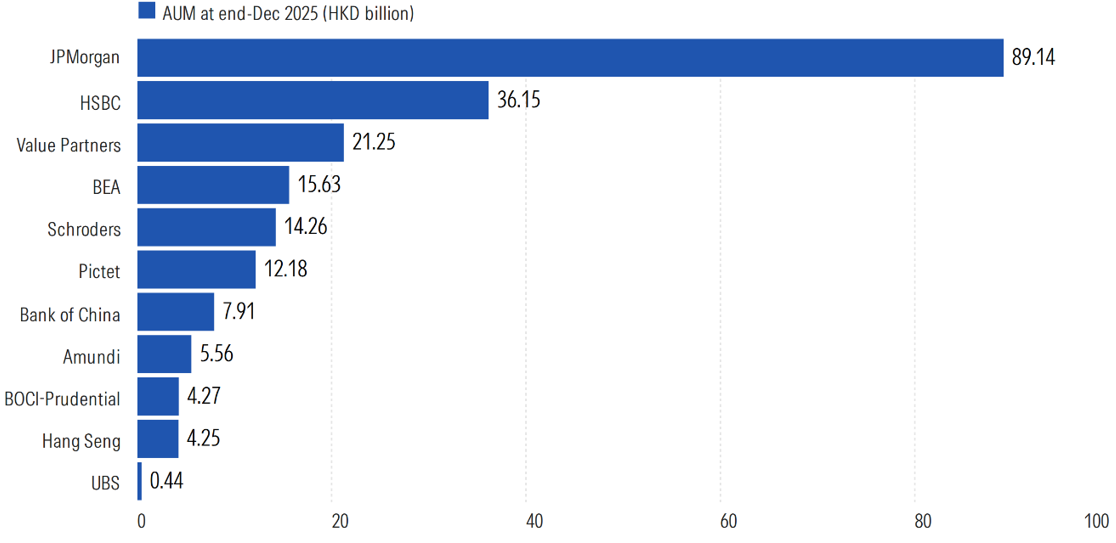
- JPMorgan and HSBC consistently held the top two positions in terms of the northbound MRF market shares in 2025. As of end of December 2025, their MRF products’ assets under management were HKD 89.14 billion and HKD 36.15 billion, respectively, together accounting for over 60% of the total assets of MRF products in the market.
Top MRF Northbound Fund Houses by AUM
All flow and AUM figures provided in this article are at the fund level.
Data lists used in this article are based on data availability. Should any fund house wish to submit timely data, please feel free to contact Morningstar.
