


- Fund inflows within the northbound MRF universe remained tilted toward equity and allocation strategies during Q3 2026, while most fixed-income products continued to face redemptions.
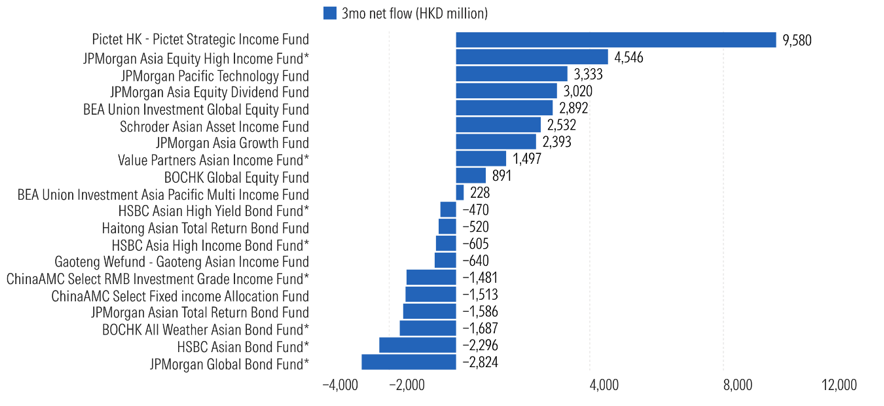
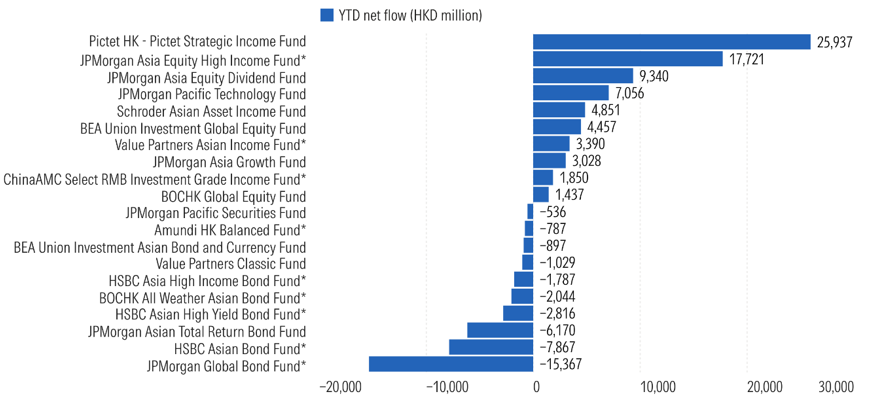
- Among equity funds, net inflows were led by JPMorgan’s income-oriented and thematic offerings. JPMorgan Asia Equity High Income attracted HKD 4.55 billion in Q3, lifting year-to-date inflows to HKD 17.72 billion, the highest among equity funds over both periods. The strategy seeks a total income of 7% to 9% over the cycle through a combination of dividend-paying stocks across Asia-Pacific ex Japan and a covered-call overlay. JPMorgan Asia Equity Dividend, which is the Asia Equity High Income strategy’s equity portfolio without the covered-call overlay, also gathered HKD 3.02 billion during the quarter, bringing its year-to-date inflows to HKD 9.34 billion. Together, the two funds were among the largest equity-fund recipients of net inflows in 2026 so far. Meanwhile, JPMorgan Pacific Technology attracted HKD 3.33 billion in Q3, bringing year-to-date inflows to HKD 7.06 billion. Focused on leading technology companies across Asia-Pacific, including Japan, the fund has recorded sizeable inflows since Q2 amid strong performance in technology-related stocks, with top holdings such as TSMC, Samsung Electronics, and SK Hynix benefiting from the AI trade.
- The biggest winner of 2026 so far is an allocation fund. Pictet HK - Pictet Strategic Income garnered HKD 9.58 billion in Q3, bringing year-to-date inflows to HKD 25.94 billion, the highest across the MRF universe. Strong year-to-date performance contributed to the continued inflows. Schroder Asian Asset Income gathered HKD 2.53 billion in Q3 and HKD 4.85 billion year-to-date. The strategy targets attractive income in Asia, with equity dividends and bond coupons expected to account for at least 70% of its payout. It invests across Asian equities and fixed income, with additional flexibility to allocate to global assets and cash, and has comfortably outpaced its Asia allocation category peers this year. Newly added Value Partners Asian Income, another Asia and income-focused allocation strategy, recorded HKD 1.50 billion in Q3 inflows and entered the quarter’s top 10 recipients. The fund was approved under the northbound MRF scheme in July 2026 and became available to mainland retail investors on September 30. One theme is clear: investors are drawn to the stable income that these types of funds offer. That said, investors should be aware that, despite Pictet HK - Pictet Strategic Income’s fund name, income generation is not the strategy’s central aim; this highly flexible global allocation approach seeks superior risk-adjusted total returns while offering downside protection.
- Conversely, fixed-income funds continued to face broad redemption pressure. JPMorgan Global Bond recorded HKD 2.82 billion outflows in Q3, taking year-to-date redemptions to HKD 15.37 billion, the highest in both periods. Asian bond funds also remained under pressure, with HSBC Asian Bond losing HKD 2.30 billion in outflows during the quarter and HKD 7.87 billion year-to-date. BOCHK All Weather Asian Bond and JPMorgan Asian Total Return Bond reported additional Q3 outflows of HKD 1.69 billion and HKD 1.59 billion, respectively. Volatility in USD bond yields, weaker year-to-date performance relative to equity and allocation products, and competition from onshore fixed-income strategies may have contributed to the weaker flow picture for offshore bond funds. In addition, some fixed income products suspended mainland subscriptions as they approached their sales caps, limiting the scope for further inflows from mainland investors.
- Product supply also broadened during the quarter. Fidelity Global Investment Fund - Hong Kong Bond and Taiping Greater China New Momentum Equity, both approved in February 2026, became available to mainland individual investors in August. Notably, the Fidelity fund became the first Hong Kong bond fund available under the northbound MRF scheme. Value Partners Asian Income, discussed above, followed on September 30. Meanwhile, several additional funds from Allianz Global Investors, UBS, BlackRock, and E Fund were approved under the northbound MRF scheme during the quarter, although their mainland share classes had not yet been launched as of quarter-end. These approvals will further expand the investable universe under the scheme.
Top 10 and Bottom 10 MRF Northbound Funds by 3-Month Net Flow
Top 10 and Bottom 10 MRF Northbound Funds by YTD Net Flow
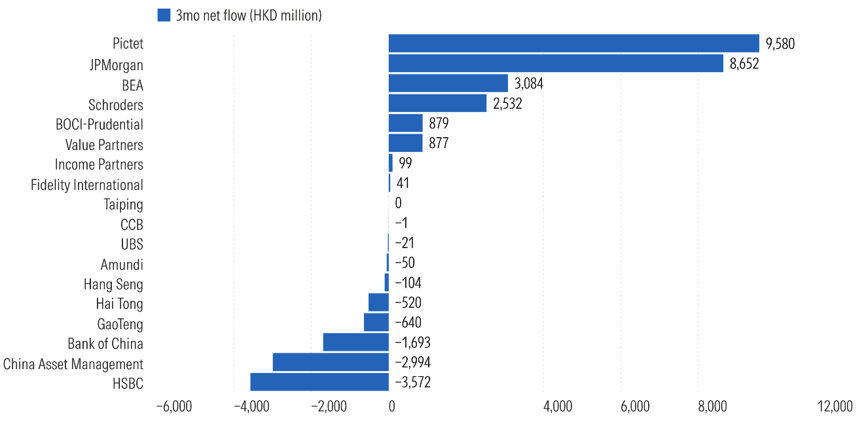
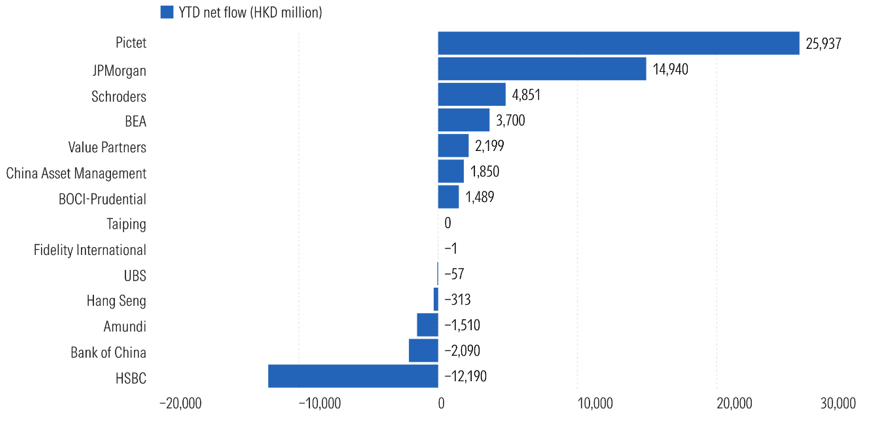
- At the fund-house level, Pictet and JPMorgan led Q3 inflows of HKD 9.58 billion and HKD 8.65 billion, respectively, taking their year-to-date totals to HKD 25.94 billion and HKD 14.94 billion. BEA and Schroders followed with Q3 inflows of HKD 3.08 billion and HKD 2.53 billion, respectively. By contrast, HSBC continued to face the most redemptions, recording Q3 and year-to-date outflows of HKD 3.57 billion and HKD 12.19 billion, respectively, primarily due to continued withdrawals from its Asian bond offerings.
Top MRF Northbound Fund Houses by 3-Month Net Flow
Top MRF Northbound Fund Houses by YTD Net Flow
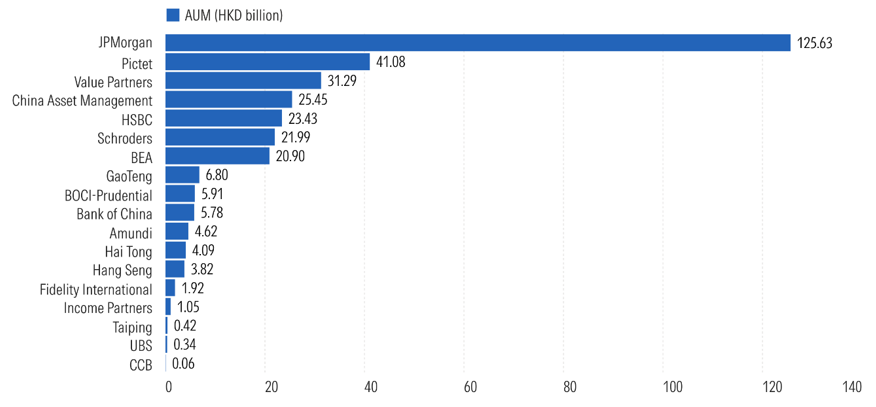
- JPMorgan remained the clear market leader, with its northbound MRF product assets under management amounting to HKD 125.63 billion at end-September, more than three times of runner-up Pictet’s HKD 41.08 billion. Value Partners ranked third and China Asset Management fourth, while HSBC slipped to fifth from third place between Q2 and Q3 amid continued redemptions from its bond lineup.
Top MRF Northbound Fund Houses by AUM
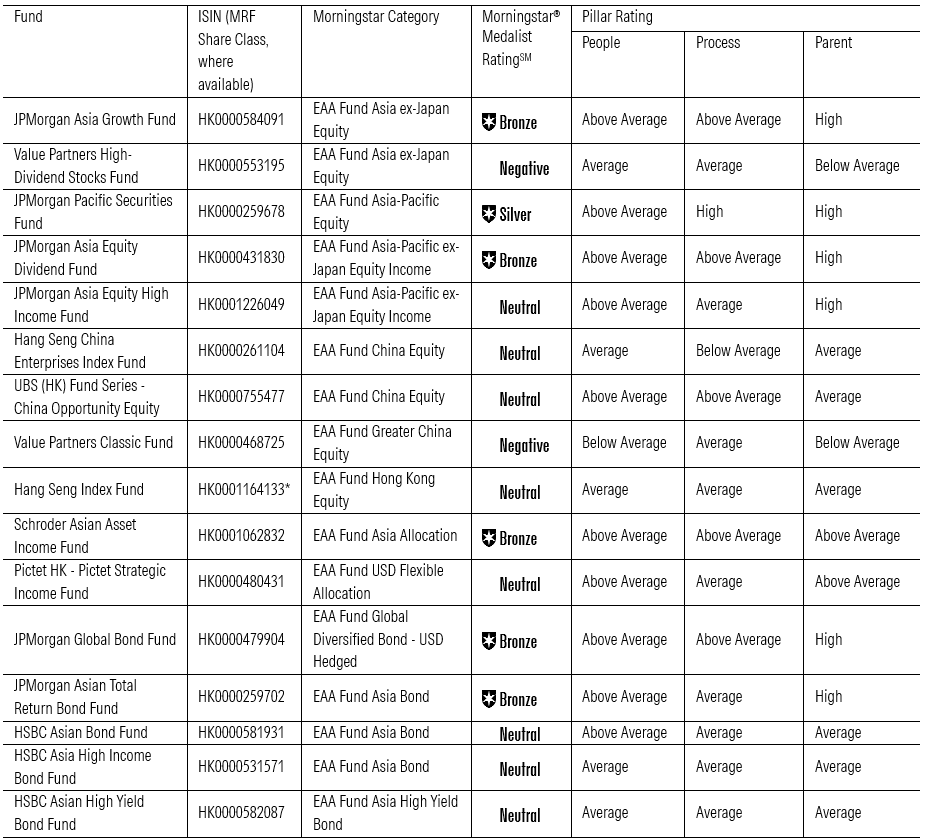
- Fund quality remains a key consideration for investors. The following northbound MRF products carry 100% analyst-driven Morningstar Medalist Ratings, reflecting our conviction in their ability to outperform their respective category peers over the long term.
List of Northbound MRF Products
All flow and AUM figures provided in this article are at the fund level.
Data lists used in this article are based on data availability. Should any fund house wish to submit timely data, please feel free to contact Morningstar.
