



The Morningstar China Active/Passive Barometer is an annual report that measures the performance of onshore China-domiciled active funds against their passive peers over both short- and long-term periods. It is a useful measuring yardstick that can help investors calibrate the odds of success of active funds in various areas based on recent trends and long-term history.
From July 2025 through June 2026, the China A-shares market advanced amid persistent volatility, while performance dispersion became increasingly pronounced. Growth stocks significantly outperformed value stocks during the period. Considering all diversified stock-heavy funds and sector funds together, more than half the active funds outperformed their passive counterparts over the long term. However, over the trailing one-, three-, and five-year periods, fewer than 50% of active funds outperformed their passive counterparts, with success rates falling below 40% over both the one- and three-year horizons. These findings underscore the growing difficulty of generating excess returns through active management across the broader universe. That said, performance patterns differed markedly between diversified stock-heavy funds and sector funds.
Our study revealed that investors still appear to face challenges in allocating money to the outperforming active managers. In most diversified stock-heavy and sector fund groups, the equal-weighted average return of active funds exceeded the asset-weighted average return. This suggests that, on average, investors have struggled to pick the active funds that would have delivered stronger excess returns. The asset-weighted average better reflects investor preferences and aligns more closely with the overall returns experienced by investors.
Exhibit 1 Active Diversified Stock-Heavy Funds & Sector Funds : 2026 Midyear Outcomes (%)
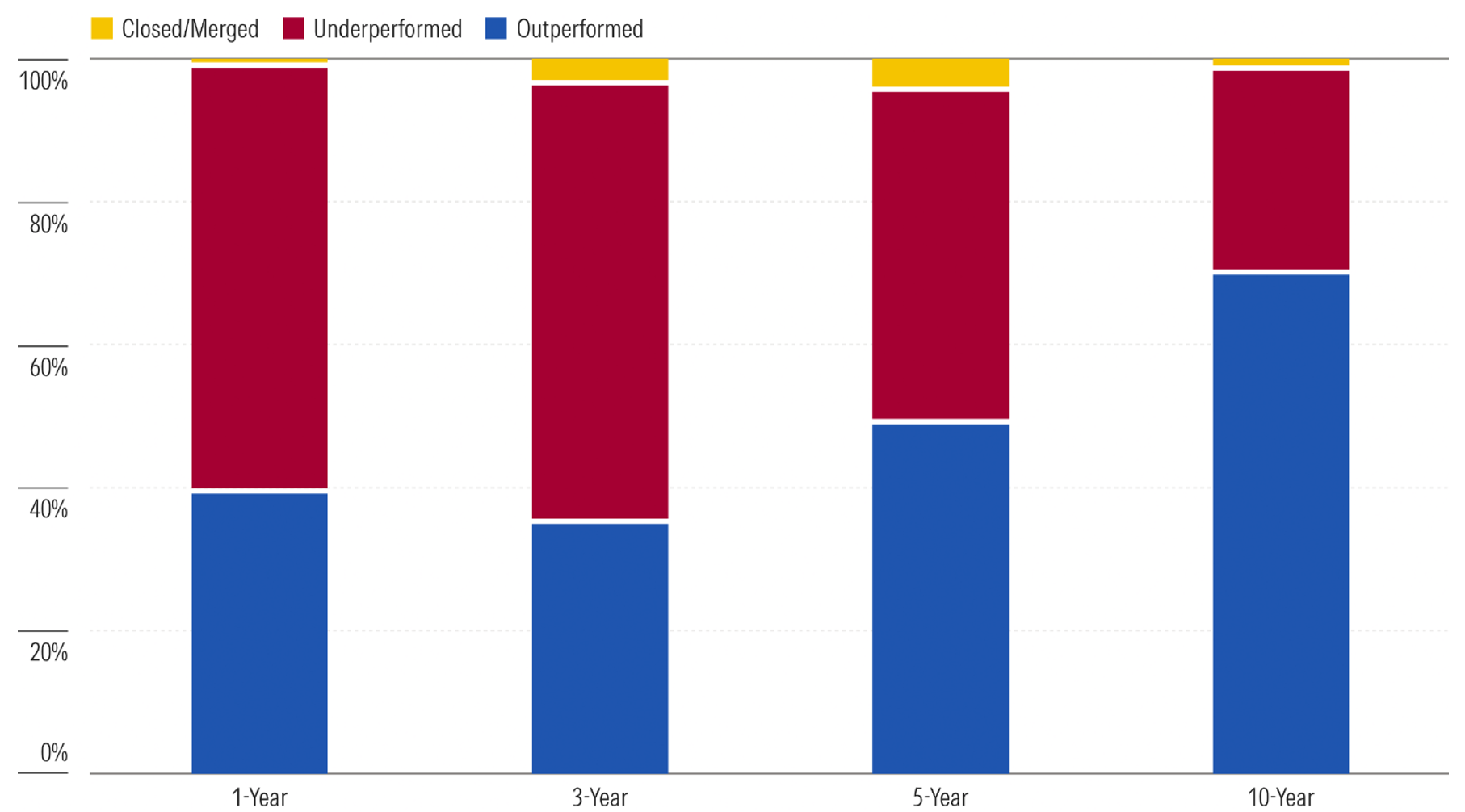
Active Diversified Stock-Heavy Funds Struggled to Beat Passive Peers
Active funds across all four diversified stock-heavy fund groups in our study — large-blend funds, large-value funds, large-growth funds, and small/mid-cap funds — saw their one-year success rates recover over the past year but continued to trail passive peers overall. Only 30.3% of active funds both survived and outperformed the asset-weighted average return of passive peers, compared to 20.6% a year ago. Over the three- and five-year periods, fewer than half the active funds outperformed, and success rates declined substantially from a year earlier, highlighting the ongoing challenge of generating excess returns within these diversified stock-heavy fund groups.
Exhibit 2 Active Diversified Stock-Heavy Funds: 2026 Midyear Outcomes (%)
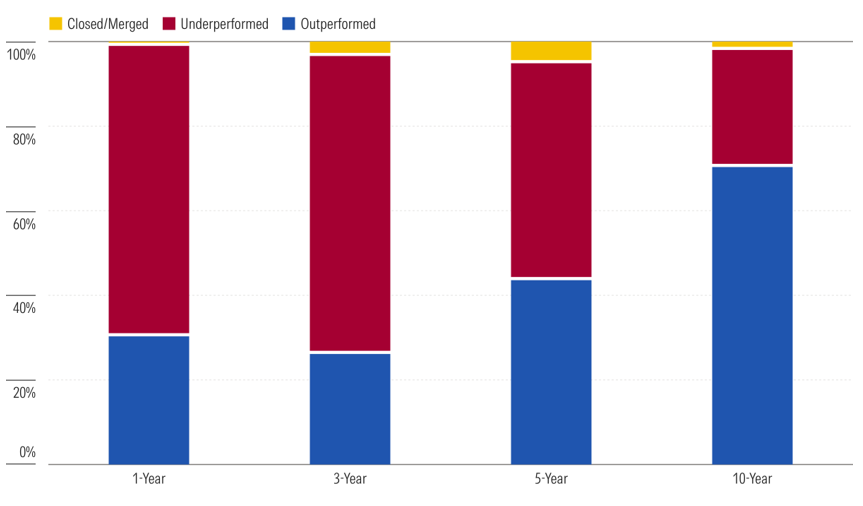
Exhibit 3 Active Diversified Stock-Heavy Funds: 2025 Midyear Outcomes (%)
Within the four diversified stock-heavy fund groups, active large-blend funds posted the strongest improvement in one-year success rates, rising 18 percentage points to 39.8%, which benefited from structural opportunities in sectors such as healthcare and artificial intelligence. Active large-growth funds also materially increased their exposure to technology compared with prior periods but remained underweight relative to passive funds in the same group. As a result, their one-year success rate improved from 13.9% to 24.7%, yet still ranked the lowest among the four groups.
Active small/mid-cap funds, which generally maintained greater exposure to small-cap stocks than passive counterparts, faced headwinds in a market environment that favored mid-cap stocks. Their one-year success rate fell to 37.6% from 48.8% a year earlier. Over longer periods, however, active small/mid-cap funds posted higher three-, five-, and 10-year success rates than active large-cap funds. A key reason is the relatively lower level of pricing efficiency in the small/mid-cap segment, which continues to provide greater opportunities for active managers to add value.
Active Sector Funds Continued to Generate Meaningful Excess Returns
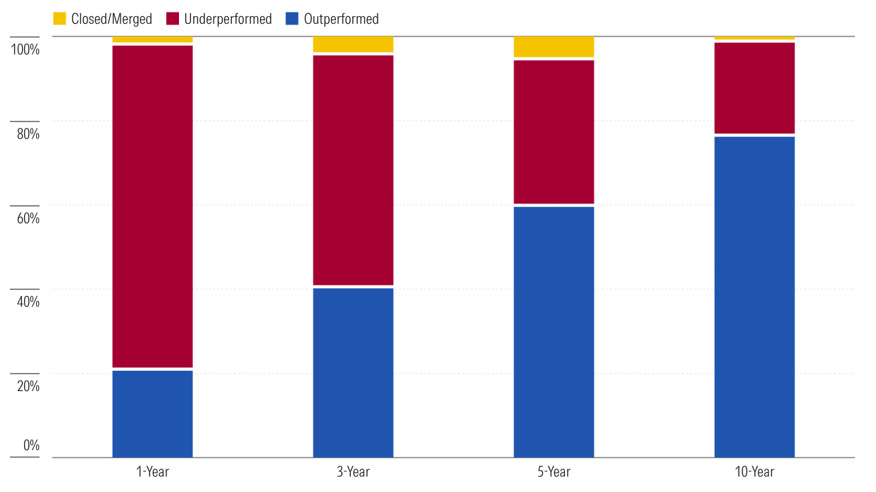
In contrast to diversified stock-heavy funds, active management continues to demonstrate a clear advantage within sector funds. As of June 2026, the overall one-year success rate among the sector funds in our study reached 69.8%, substantially higher than that of diversified stock-heavy funds and 14 percentage points above the level recorded a year earlier. It is worth noting, however, that the relatively high success rates of active sector funds are partly attributable to the composition of passive funds within certain sectors, a phenomenon that is particularly evident in the consumer sector.
Exhibit 4 Active Sector Funds: 2026 Midyear Outcomes (%)
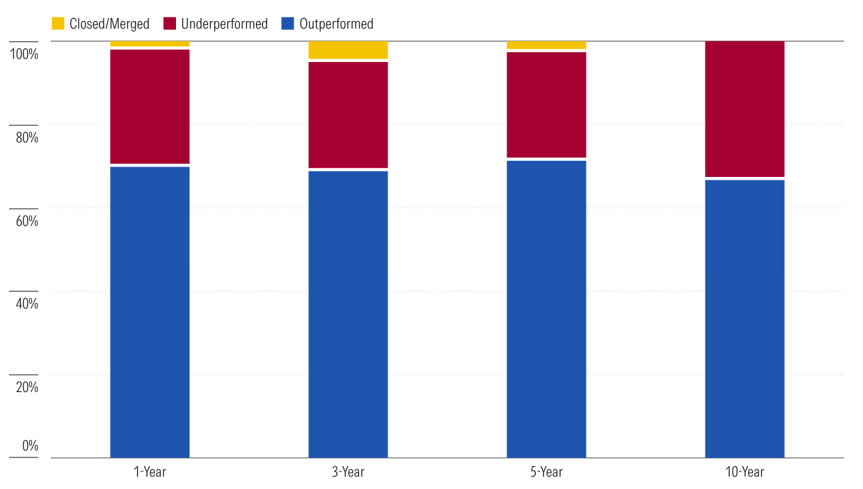
Exhibit 5 Active Sector Funds: 2025 Midyear Outcomes (%)
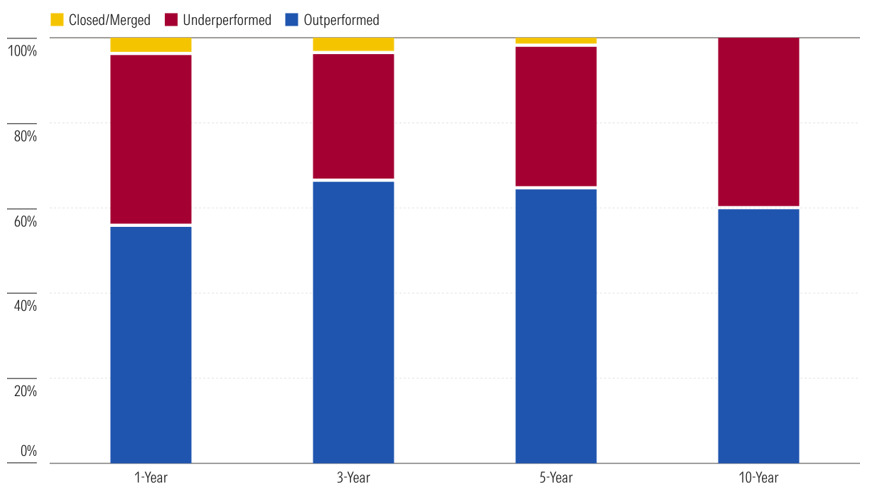
Among the three sector fund groups — consumer sector funds, healthcare sector funds, technology and communications sector funds — active funds in the technology and communications sector delivered the most pronounced improvement in performance, benefiting from their exposure to opportunities across the artificial intelligence value chain. Their one-year success rate rose by 36 percentage points to 59.6%. Despite this substantial improvement, they continued to trail active consumer and healthcare sector funds. In comparison, active consumer sector funds maintained a high one-year success rate of 79.4%, the strongest among the three sector groups. This result was driven in part by the composition of the passive universe within the consumer sector. A relatively small number of large passive funds track the CSI Liquor Index, CSI Alcoholic Drink Index, and CSI Consumer Staples Index, all of which experienced significant declines over the period. This created a wide divergence between the asset-weighted and equal-weighted returns of the passive funds in this group, boosting active consumer sector funds’ measured success rates. At the same time, many active managers maintained underweight positions in liquor while overweighting healthcare, home appliances, and electronics, further strengthening relative performance.
From a longer-term perspective, healthcare remains the sector in which active management demonstrates the clearest advantage. Across the three sector fund groups included in our study, active healthcare funds achieved success rates exceeding 80% over the three-, five-, and 10-year periods, ranking top in each time horizon. The healthcare sector encompasses a broad range of subsectors and exhibits significant stock-level dispersion, creating a fertile environment for active managers to generate excess returns through both subsector allocation and security selection. Meanwhile, passive peers remain concentrated in broad healthcare sector indexes, which primarily provide exposure to the sector as a whole.
For the full report on The Morningstar China Active/Passive Barometer: June 2026, please visit: https://www.morningstar.com/en-hk/business/insights/research/china-active-passive-barometer
