


Bond yields have climbed swiftly in 2026, driven by a combination of higher inflation and rate hikes by global central banks. In September 2026, the US Federal Reserve raised interest rates for the first time in three years, while the 10-year US Treasury yield climbed to a multidecade high of 5.3% by the end of September from 4.2% at the start of the year, before easing to around 5.0% as of Oct. 23.
Since bond yields and prices move in opposite directions, investors with fixed-income allocations have suffered losses in their portfolios this year. In the third quarter of 2026, returns of prominent fixed-income Morningstar Categories such as global bond, global government bond, and global corporate bond all fell between roughly 2% and 3%. Over the year ended Sept. 30, 2026, these categories were down 1.5% to 4.0%, with the more interest-rate-sensitive government-bond funds suffering the largest declines.
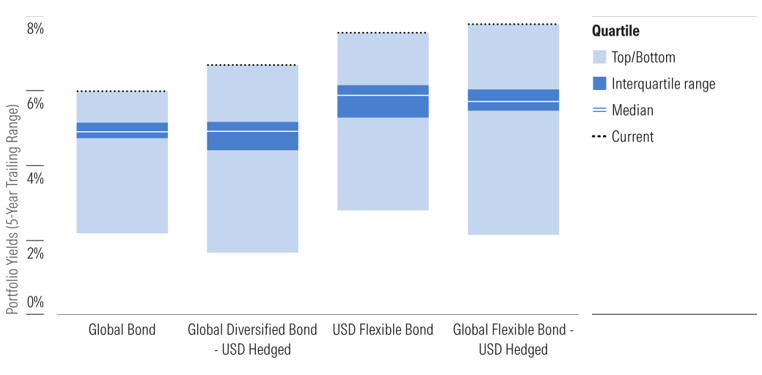
While these losses can be unsettling for investors, especially given fixed income’s role in providing portfolio stability, there is a silver lining. The rise in yields presents one of the most compelling opportunities in years (Exhibit 1), and as portfolio yields improve, investors may want to take a fresh look at fixed income.
Exhibit 1:Portfolio Yields at Multiyear Highs
What Makes Today Different From 2022?
The last time we saw a sharp rise in bond yields was in 2022, when yields during the year climbed a whopping 236 basis points on the 10-year US Treasury, and many fixed-income categories suffered negative returns. However, unlike today, yields at that time were coming off very low levels of roughly 1.5% at the start of 2022. As yields rose with central bank rate hikes, those low starting yields did little to cushion the impact of falling bond prices.
In contrast, while the direction of yields is always hard to predict, what is clearer today is that starting yields are considerably more attractive and provide a greater cushion. As Exhibit 1 shows, portfolio yields across most fixed-income categories are at multiyear highs. For instance, Pimco GIS Income, the largest fund in the global flexible-bond category, has seen its yield to maturity rise to 8.4% at the end of September 2026 from 6.3% at the start of the year. For reference, the comparable yield at the start of 2022 was 3.8%, illustrating just how much more attractive the entry point is today.
Higher starting yields also strengthen the diversification case for fixed income. If economic growth slows or inflation concerns ease, bonds could benefit from declining yields while providing some ballast against equities, particularly when many stock markets are trading at rich valuations.
To learn more about why active managers may have an edge in volatile rate environments, along with fund ideas for investors to consider, read the full report here.
