



Last year was a roller coaster. While structural drivers such as artificial intelligence proliferation and corporate governance reforms buoyed Asian markets in 2025, fast-evolving trade negotiations, ongoing geopolitical tensions, and concerns over slowing economic growth introduced volatility and widened performance dispersions among major Asian markets. As we enter 2026, we draw on Morningstar’s extensive on-the-ground research and frequent interactions with portfolio managers across Asia to explore the key themes shaping their strategies.
Equity
Asian equities were propelled by technology companies in 2025, fueled by the ongoing AI boom, a trend that mirrored the rally in the US market. The Morningstar Asia ex-Japan Target Market Exposure Index returned around 32% in US-dollar terms, extending its gains from just over 10% in 2024.
Exhibit 1: Volatile Asian Equity Markets Present Opportunities and Challenges
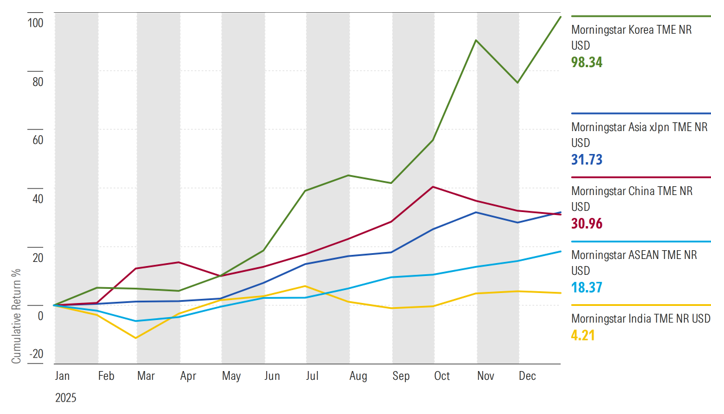
China equities have reignited market interest following technological transformations and policy support. That said, a slowing economy, overcapacity, and geopolitical tensions remain. Against this backdrop, fund managers are focusing on selective bottom-up opportunities with sustainable competitive advantages. Louisa Lo, manager at Schroder ISF Emerging Asia, steered away from overly crowded areas such as AI-related hardware companies and instead preferred more reasonably valued internet companies poised to benefit from AI advancements, such as Alibaba.
Following a couple of years of strong performance, Indian equities suffered a steep correction in early 2025, and India was the weakest-performing major Asian equity market despite ending the year in positive territory. On the bright side, this also brought valuations to a more reasonable level for select Indian companies. For instance, investors at Fidelity believe that India remains one of the most attractive long-term growth stories in the region, supported by robust economic growth and a benign inflation backdrop, which creates room for further interest rate cuts.
Meanwhile, the South Korean government rolled out a corporate value-up program in 2024, which has influenced how portfolio managers position themselves in the market. For example, investors at FSSA note early signs of meaningful change in the Korean corporate governance landscape, though they believe reforms will likely take time. Martin Lau of FSSA Asian Equity Plus added to LG Corporation over the course of 2025, which he believes has been among the most progressive in corporate governance.
In ASEAN markets, Pauline Ng, lead manager of JPM ASEAN, remained constructive on the supply chain diversification opportunities on offer in the region, while other managers favored Singapore as a source of defensiveness for their portfolios.
Fixed Income
In 2025, despite growth and inflation-related uncertainties stemming from the impact of trade tariffs, US Treasuries delivered solid returns, supported by a series of Federal Reserve rate cuts. The year also proved favorable for riskier credit assets, as spreads compressed across the board, with emerging-market debt among the top-performing segments.
There is a broad consensus among managers that Asian credit fundamentals are expected to remain resilient in 2026, with default expectations staying low. However, a common concern is the relatively tight valuations, which leave limited room for meaningful spread compression.
From a country positioning perspective, India remains a consensus favorite among Asian credit managers. The country’s macroeconomic strength and robust growth driven by domestic demand are frequently highlighted as key positives. Building on last year’s trend, many managers also continue to favor offerings from the broader Asia-Pacific market, notably Japan and Australia, supported by high credit quality and reasonably attractive yields.
The troubles at prominent real estate developer New World Development over the past year have led managers to adopt a more cautious stance toward the Hong Kong property sector. Meanwhile, China remains out of favor for most investors. Within the higher-quality investment-grade segment, managers note that Chinese credits are trading at very tight valuations, reducing their attractiveness. On the other hand, within the high-yield market, challenges within the country’s property sector remain persistent, as evident from the recent developments at real estate developer Vanke, keeping managers cautious.
To learn more about what is top of mind for Asian portfolio managers and how they are positioning their portfolios to navigate the year ahead, please access our full report, Starting 2026 on the Right Foot.
