
US Stock Market Outlook Key Takeaways
- The US stock market is trading at a 9% discount to a composite of our valuations.
- Undervaluation is extremely concentrated. Excluding just seven mega-cap stocks, the remaining market is at fair value.
- Macrodynamics are increasingly challenging for the equity market.
- The growth category is more attractive based on the combination of lower prices and higher valuations.
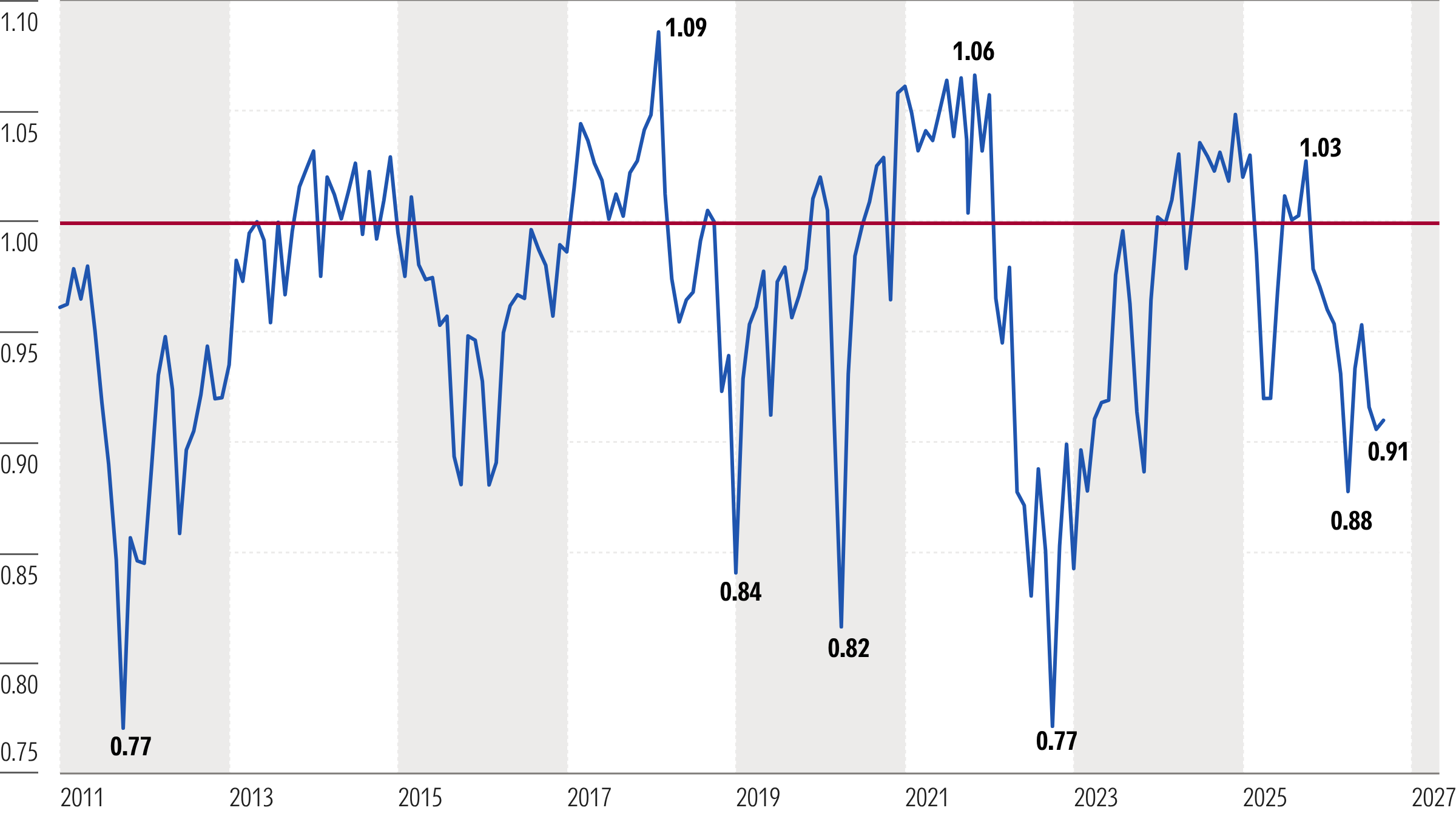
Based on a composite of our intrinsic valuations of the stocks we cover included in the Morningstar US Market Index, as of Aug. 31, 2026, the US equity market was trading at approximately a 9% discount to our fair value estimates.
Yet, while the broad market appears to be trading at an attractive margin of safety below our valuations, we think the US stock market is entering a potentially risky stage. Valuations are extremely concentrated, momentum has reversed course, and macrodynamics are turning negative.
Undervaluation Concentrated in Only 7 Stocks
Undervaluation is predominantly concentrated in just seven mega-cap stocks: Nvidia NVDA, Alphabet GOOGL, Broadcom AVGO, Microsoft MSFT, Meta Platforms META, Amazon.com AMZN, and Tesla TSLA. Each, to some degree, depends on our forecasts for the continued growth of the artificial intelligence buildout boom and ultimately the economic value created by AI. Excluding these seven from our valuation composite, our remaining coverage would indicate the US Market Index is trading at a fair value.
Excluding Microsoft, which has bounced off a one-year downward trend, the rest of these stocks have lost ground since the beginning of June. The market no longer seems to be giving these companies the benefit of the doubt for the amount of growth they can realize. While they have provided strong growth guidance for 2027 and into 2028, the market is discounting the amount of growth three to five years from now.
Momentum Has Rolled Over
Over the past two months, not only has momentum to the upside run out for the commodity-oriented technology hardware stocks, but most of those stocks have also rolled over and been on a downward trend. Even after falling as much as they have, stocks such as SanDisk SNDK and Ciena CIEN are still some of the most overvalued across our coverage and may have further to fall. Considering many of these high-momentum stocks have been chased higher by leveraged investors using margin accounts, further selloffs could be exacerbated if margin calls lead to forced selling.
Ugly Macrodynamics
On the macrodynamic front, several headwinds have been building, which usually cause us to turn cautious.
- Long-term interest rates have been rising in both the United States and internationally.
- The Federal Reserve is expected to start tightening monetary policy as the market is pricing in at least one, if not two, hikes to the federal-funds rate by year-end.
- Inflation will likely remain elevated as oil prices continue to climb higher.
- US economic growth is heavily supported by high capital-expenditure spending on the AI buildout boom and its related economic multiplier effect.
- International economies such as Europe are relatively stagnant, and the Chinese economy may be weaker than reported.
- Lastly, the potential for systematic risk from rising interest rates on Japanese government bonds and a weakening yen continues to increase.
Price/Fair Value of Morningstar's US Equity Research Coverage at Month-End
Positioning for the Remainder of 2026
At the beginning of the third quarter, we recommended investors move to an equal weight across styles, as no one category was trading at much more of a discount than any other.
Since then, the value category has surged higher, as represented by the Morningstar US Value Index, which has risen 7.3% quarter to date. The Morningstar US Core Index rose 2.3%, in line with the broad market. Growth stocks, however, have been trounced, with the Morningstar US Growth Index dropping 4.1%.
The greatest contributors to losses in the growth category were overvalued AI stocks such as Intel INTC, Applied Materials AMAT, and KLA KLAC. In addition, many of the most overvalued commodity-oriented tech hardware stocks fell significantly, including SanDisk, Micron MICR, Western Digital WDC, and Ciena.
Yet, while many of these overvalued commodity-oriented AI stocks have corrected to the downside since June, we increased our fair values on a number of those we see as technological leaders in AI. For example, we increased our fair value estimates for Nvidia, Marvell MRVL, and Taiwan Semiconductor TSM.
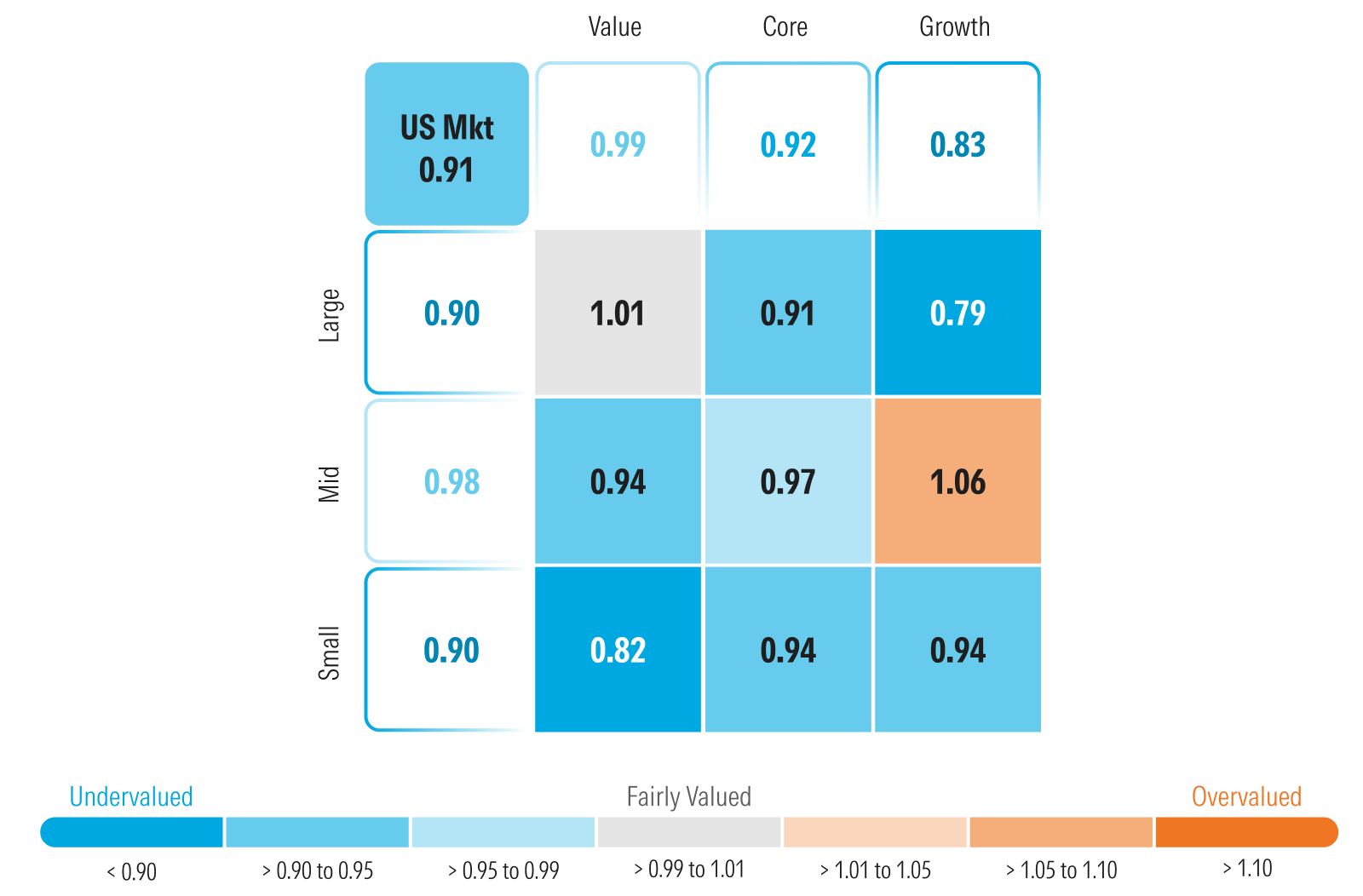
The growth category is now at a 17% discount from our fair values. Among core stocks, the index return and our valuation increases were substantially similar, and as such, the category remains at an 8% discount. Risk-off sentiment in growth stocks sent investors to the perceived safety of value stocks. Market returns have brought the value category in line with our valuations.
Based on our valuations, we advocate beginning to overweight the growth category and underweighting the value category while remaining market weight in the core category.
By capitalization, the Morningstar US Large-Cap Index rose 2.62% and the Mid-Cap Index rose 2.27% compared with the US Market Index’s return of 2.35%. The Small-Cap Index declined by 0.34%. Based on our valuations, we advocate overweighting large and small caps and underweighting mid caps.
Price/Fair Value by Morningstar Style Box
Where We See Opportunity by Sector
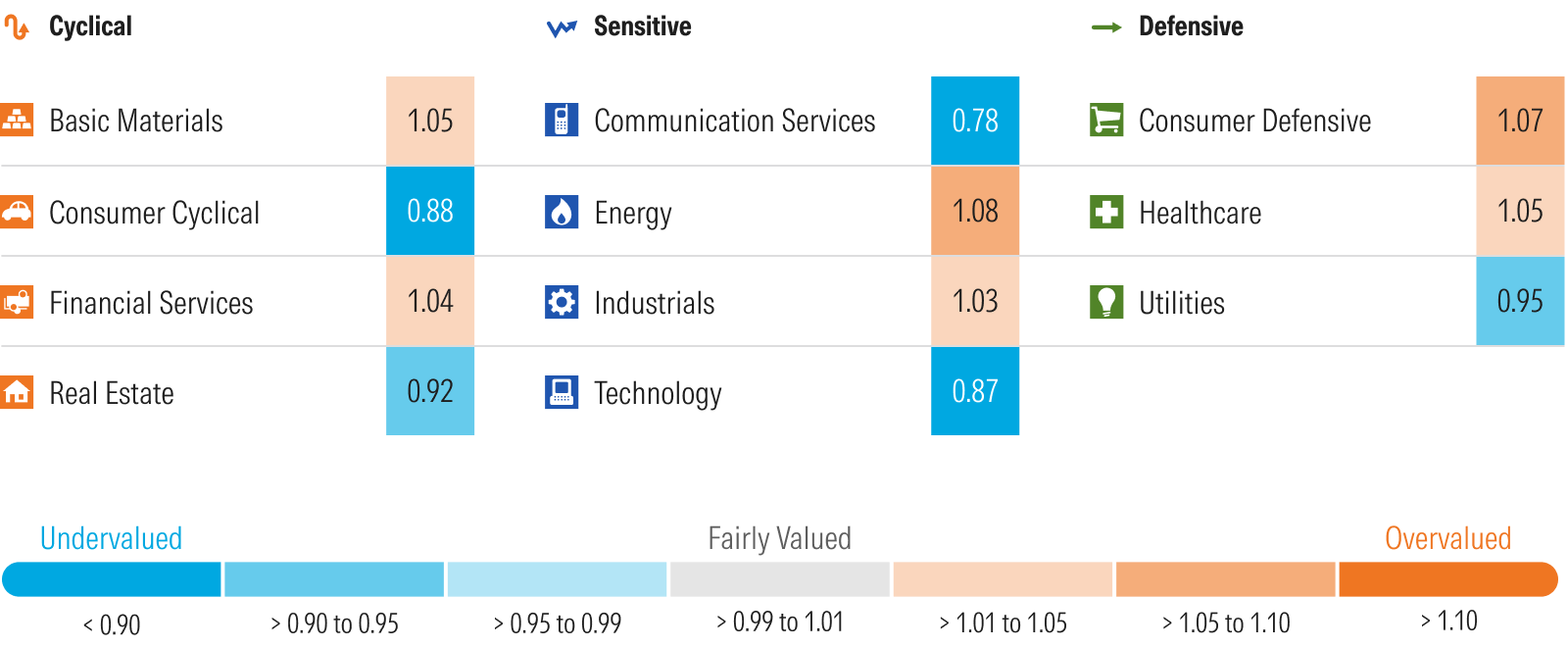
In the quarter to date, returns have been widely dispersed among sectors, with some significant valuation swings as a result. The greatest change occurred in the energy sector, which has been especially volatile this year as oil prices have swung amid on-again/off-again hostilities with Iran. Energy started the year as one of the most undervalued sectors, surged to the most overvalued by the end of March, and then fell back to undervalued by the end of June.
This volatility has allowed investors to capture gains by adjusting their weightings in relation to the swings in valuation. In the quarter to date, the Morningstar US Energy Index rose almost 20%, bringing the sector’s valuation to an 8% premium from a 7% discount.
The industrials sector has had the second-greatest swing in valuations. The Morningstar US Industrials Index has dropped almost 8%. The sector is now only trading at a 3% premium, whereas it was the most overvalued sector at the beginning of the quarter, when it traded at a 14% premium. The greatest detractors to the sector returns were concentrated in overvalued stocks closely tied to the AI buildout boom.
The valuation for the utility sector has dropped from a 5% premium to a 5% discount. The Morningstar US Utilities Index dropped almost 8% quarter to date, largely on the back of rising interest rates.
Morningstar’s US Financials and Healthcare indexes have each risen about 7% quarter to date. The financials sector has risen to a 4% premium from a 2% discount, and the Healthcare Index has risen to a 5% premium from a 2% premium.
At a 22% discount, the communications sector remains the most undervalued. In our view, one of the greatest differentials versus the market is Meta, which accounts for 19% of the sector market capitalization and trades at a 32% discount. Similarly, Alphabet accounts for 55% of the sector market capitalization and trades at a 23% discount.
The technology sector is the second most undervalued at a 23% discount. While we continue to see value for long-term investors in companies at the leading edge of AI technology, we continue to caution investors to steer clear of overvalued commodity-oriented hardware. Undervalued Microsoft was by far the single greatest contributor to the sector return quarter to date, rising over 36%.
Undervalued software stocks were also significant contributors to the index return. Our investment thesis on software has long been that the larger software providers are incorporating AI into their products and services to provide more economic value to their clients. As such, while smaller, niche-oriented software providers may be at risk of disruption or displacement by AI, the larger platforms will benefit.
The consumer defensive sector remains overvalued, trading at a 7% premium to fair value. While Walmart WMT stock has declined enough to slide into 2-star territory from 1 star, it remains significantly overvalued. Considering it accounts for 15% of the sector, its overvaluation skews the sector valuation higher. Similarly, 2-star-rated Costco COST accounts for 14% of the sector and skews the valuation upward. Excluding these two stocks from our valuation, the remainder of the sector is trading at a 2% discount.
Consumer cyclicals are at a 12% discount, but that discount is skewed downward by Amazon and Tesla. Amazon is 38% of the sector’s market cap and trades at a 15% discount, while Tesla constitutes 15% and trades at a 21% discount.
Morningstar Price/Fair Value by Sector